
Why Balcony and Planter Boxes Leak — and How to Stop It
A planter box is the hardest thing in a residential building to keep watertight, and it is worth being clear about why. Every other wet area dries out between uses. A planter never does — it holds damp soil in permanent contact with the structure, gets watered on top of the rain, and hides the whole interface under 300mm of earth where nobody can inspect it.
Balconies are the same problem with less soil and more sun.
The five things that usually go wrong
- 1
Blocked drainage
Almost always first. Soil, root matter and debris block the outlet, the planter fills, and water sits against the membrane at a depth it was never designed to resist. The single most common cause and the easiest to prevent.
- 2
Failed or missing upturn
The membrane must run up the inner face of the planter wall to above the soil line. Stopped short, the soil simply wicks water over the top of it.
- 3
Root penetration
Roots find and enlarge every weakness. Without a root-resistant layer or a protection board, they will reach the membrane eventually.
- 4
Movement cracks in the slab or kerb
Thermal cycling on an exposed balcony opens hairline cracks. A rigid cementitious membrane cannot bridge them.
- 5
Failed junctions
The balcony-to-door threshold, the planter-to-wall corner, and the drain outlet collar. Water goes through interfaces, not through the middle of surfaces.
If a planter has ever overflowed after heavy rain, treat it as a drainage problem before treating it as a waterproofing one. A membrane holding back a permanently flooded planter has a short life regardless of who applied it.
Where the damage shows up
- A damp band along the ceiling of the room below, following the planter footprint
- Staining on the external wall directly under the balcony slab edge
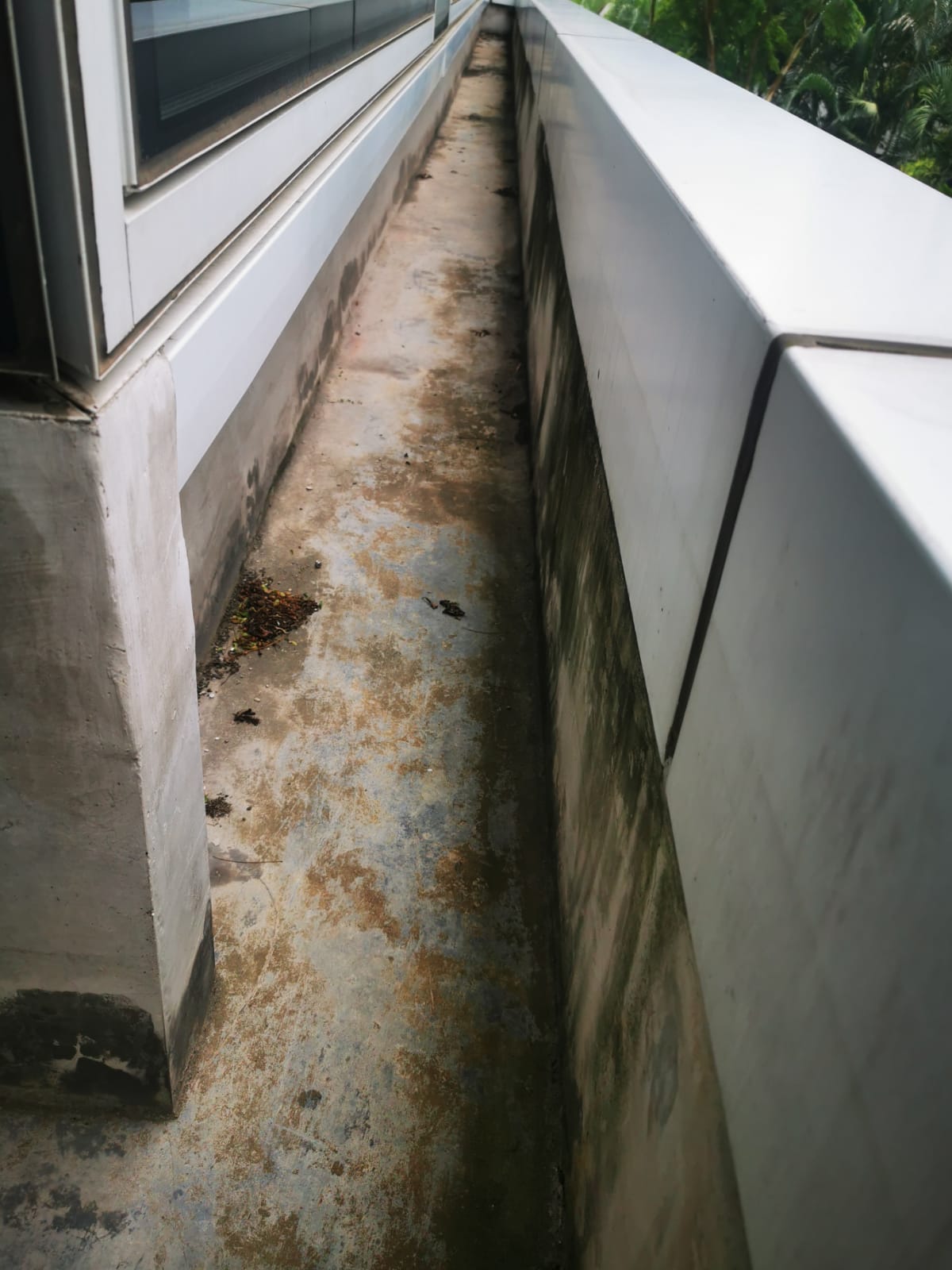
- Efflorescence or white deposits on the underside of the slab — a reliable sign water is moving through the concrete
- Blistering paint on the inner face of the planter wall
- Rust staining, then bulging — corrosion reaching the reinforcement
- Persistent damp at the base of the balcony door frame
It is worth noting how much of this only appears in the wet season. December is typically the wettest month in Singapore, during the Northeast Monsoon, and the inter-monsoon months bring frequent afternoon thunderstorms. Damp that surfaces on that schedule is telling you the water is coming from outside.
What a repair that lasts looks like
For a planter, a proper rebuild of the system means clearing it out entirely and building back in the right order:
- Remove the soil and any existing failed layers back to the concrete
- Repair cracks and reinstate any spalled concrete before coating anything
- Form falls so water actually reaches the outlet
- Apply the membrane across the base and up the full inner face, above the finished soil line
- Add a root-resistant or protection layer over the membrane
- Install a drainage cell or aggregate layer with a filter fabric above it
- Fit a drain outlet with a removable, cleanable grating
- Test with ponding before backfilling — this is the only chance to test it
Backfilling before testing is the mistake that turns a repair into a rebuild. Once the soil is back in, verifying the membrane means taking it all out again.
For an exposed balcony, the sequence is simpler but the material choice matters more: a flexible liquid membrane that can accommodate thermal movement and UV, rather than a rigid cementitious slurry. See the membrane comparison for how the families differ.
Maintenance that genuinely prevents this
Every month
Clear the planter and balcony outlets of soil and leaf litter. Pour a bucket of water in and watch it drain.
Every wet season
Check the underside of the slab and the ceiling below for new staining after the first heavy downpours.
Yearly
Inspect the balcony door threshold seal, the kerb-to-wall junction and any visible cracking in the slab edge.
When planting
Avoid vigorous, deep-rooting species in a shallow box, and keep soil below the top of the membrane upturn.
If the ceiling below is already stained, deal with the source before making it good. Skimming and repainting a wet ceiling buys a few dry months and nothing more.
Frequently asked
Why does my planter box keep leaking after being waterproofed?
The most common reason is drainage. If the outlet blocks with soil and root matter, the planter fills and holds standing water against a membrane that was never designed for that pressure. The other frequent cause is an upturn that stops below the soil line, letting damp soil wick water over the top of the membrane. Both defeat good waterproofing.
Can a planter box be waterproofed without removing the soil?
Rarely with any confidence. The membrane sits under the soil, and its base and upturn are exactly where the failure usually is. Injection can sometimes seal a specific crack from the underside, but rebuilding the system means clearing the box out — which is also the only opportunity to test it before backfilling.
How often should I clear my balcony and planter drains?
Monthly is reasonable in Singapore, and before each monsoon period at minimum. Pour water in and confirm it drains away freely rather than just checking that the grating looks clear.
Where this information comes from
All guidesKeep reading
Waterproofing Membranes Compared: Cementitious, PU, Acrylic and Torch-On
Each system fails in a different way. How to match the membrane to the surface, the exposure and the water it must hold.
Leak DiagnosisMonsoon-Proof Your Landed Home: Roof and Wall Checklist
What to check before the wet season, from gutters and flashing to wall coatings and drainage falls.